
NEWS
VP’s Aide Calls for Transport Sector Overhaul, Integrated System to Unlock Nigeria’s Economy

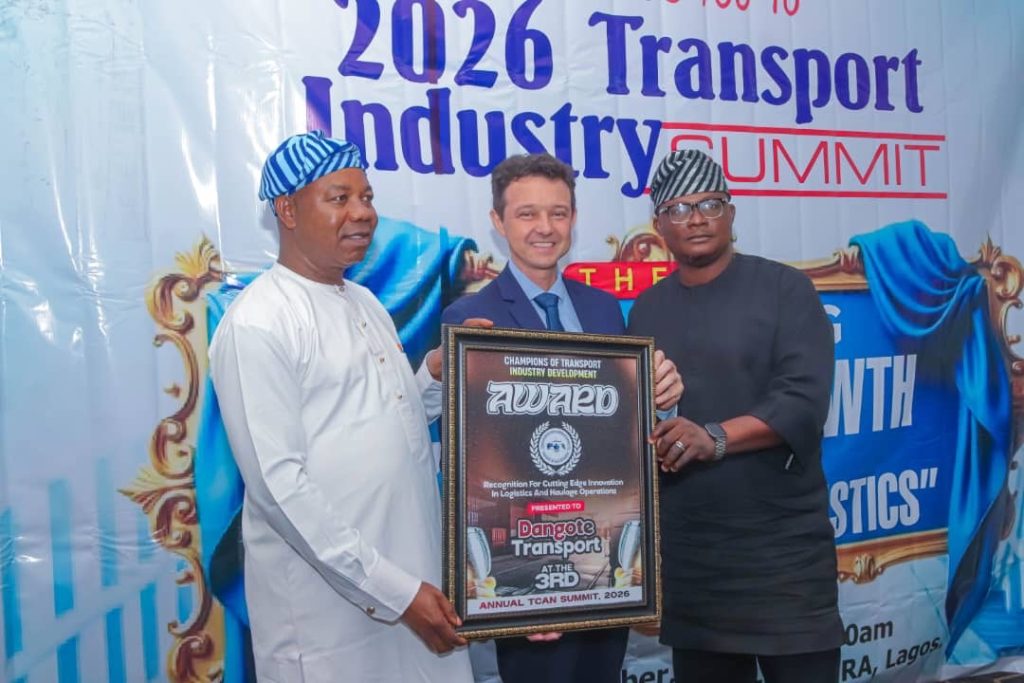
The Federal Government has been urged to accelerate the transformation of Nigeria’s transportation and logistics system through greater integration of road, rail, waterways, ports and other modes of transport, with technology and professional regulation deployed to reduce the cost of moving people and goods.
Technical Adviser to the Vice President on Transportation, Logistics and Innovation, Prince Segun Ochuko Obayendo, made the call on Thursday, at the 2026 Transport Industry Summit organised by the Transportation Correspondents Association of Nigeria (TCAN) at the Radisson Hotel in Lagos.
Obayendo said Nigeria could not unlock its economic potential without addressing the structural weaknesses in its transport and logistics system, arguing that delays, fragmented modes of transportation, multiple checkpoints, insecurity, poor coordination and informality in the road transport sector were adding significantly to the cost of doing business.
He said Nigeria should learn from countries such as Singapore, Germany and China, where transportation infrastructure has been deliberately integrated into broader economic development strategies.
According to him, Singapore provides an example of how intelligent transport systems, automation and integrated ticketing can make movement across different modes of transport more seamless.
“Most of their automation-wise, intelligent transport systems, if you ask me, I would say they are leading in terms of automation and ITS,” he said.
He pointed specifically to Singapore’s public transport system, where fares are calculated across connected bus and rail journeys rather than requiring passengers to pay a separate boarding charge every time they change modes.
Singapore’s Land Transport Authority and Public Transport Council confirm that the country’s distance-based fare system covers bus and MRT/LRT journeys, with passengers able to make transfers without additional boarding charges when the applicable transfer rules are met.
Account-based payment systems also allow commuters to use contactless bank cards and mobile wallets across the network.
Obayendo said Nigeria needed to move towards a similar level of integration, stressing that the objective should not merely be to construct individual transport projects but to create a system in which the different modes complement one another.
“When you have one ticket, you should be able to book your journey across the different modes. That is what multimodality is talking about,” he said.
He also cited the Hamburg port ecosystem in Germany as an example of how technology and coordinated logistics can improve the movement of goods.
He said Nigeria needed to develop systems that could track cargo and monitor the movement of goods from one point to another, thereby reducing delays and improving transparency.
Obayendo referred to the Hamburg Port Authority’s smartPORT programme, as an example of the type of integrated system he wants Nigeria to build. The port combines road, rail and sea transport data, while its digital systems monitor traffic flows, infrastructure and cargo movements.
Its Port Monitor system brings together information including vessel positions, berths, water levels and other operational data, while other projects use sensors, connected vehicles and automation to improve traffic flow.
Obayendo said such systems demonstrated that efficient transportation was not simply about building roads, bridges or terminals, but about connecting infrastructure, data, operators and users.
He also drew attention to China, describing the country as an economic powerhouse whose development had been closely linked to massive investment in transport infrastructure.
He argued that China’s ability to produce goods on a large scale would have limited economic value without an equally strong capacity to move those goods to domestic and international markets.
“China is the economic powerhouse of the world,” he said. “How did they attain that economic powerhouse? It is transportation.”
According to him, China’s comparative advantage was not based solely on natural resources or cheap labour, but was reinforced by deliberate investments in infrastructure, logistics and connectivity.
He said Nigeria should similarly examine its strategic position in Africa and ask why the country’s potential as a major regional trading hub had not translated into the volume and efficiency of trade flows that should be expected.
“If we get things right, we will be able to move goods freely, earn more, create more jobs and be prosperous,” he said.
Obayendo said the economic consequences of an inefficient transport system were ultimately borne by consumers and businesses.
He explained that when an importer experiences delays in moving goods from a port or terminal, the additional costs are eventually incorporated into the price of the goods.
“If I were an importer and my goods are delayed for a week or two when they are supposed to move freely, whatever is the cause of that delay would be added to the final price,” he said.
He recalled the severe gridlock that previously affected the Apapa port corridor, saying improvements in the movement of containers had demonstrated the economic importance of tackling transport bottlenecks.
He also raised concerns about the proliferation of checkpoints and other charges along freight corridors, saying such costs accumulate and ultimately increase freight rates.
The challenge is particularly significant because Nigerian businesses depend heavily on road transportation for the movement of cargo between ports, industrial centres, markets and inland destinations.
Obayendo said the issue was not simply about the number of checkpoints but the cumulative effect of informal payments, delays and other costs imposed on transport operators.
“The cost is passed on. At the end of the day, you are going to pay for it directly or indirectly,” he said.
Another major issue raised by the presidential adviser was the absence of adequate integration among Nigeria’s different transport modes.
He argued that a cargo movement that could be completed much faster through a combination of road, rail and water transport could take considerably longer when the entire journey was forced onto the road.
Using a case study from his professional experience, Obayendo said an integrated movement involving rail or inland waterways for part of a journey and road transport for the final leg could significantly reduce travel time.
He said a journey that could potentially be completed within about 10 hours through an integrated system could take several days when carried out entirely by road.
The argument is consistent with the Federal Government’s newly unveiled National Land Transport Policy, which seeks to move Nigeria away from isolated transport projects towards an integrated system in which roads, railways, ports and inland waterways complement one another.
The National Land Transport Policy was unveiled in September 2026, with the Federal Government describing it as the country’s first national policy framework specifically designed to provide coordinated direction for land transportation.
Obayendo said the policy was important because transportation should not be left to administrative discretion or fragmented institutional arrangements.
He noted that Nigeria had operated for decades without a comprehensive national land transport policy, making it difficult to maintain continuity and coordination across successive administrations and institutions.
Obayendo devoted significant attention to Nigeria’s road transport sector, describing it as one of the areas requiring the most urgent transformation.
He said stakeholders brought together recently to discuss a proposed road transport transformation initiative had broadly agreed that the sector needed reform, standardisation, stronger standard operating procedures and greater professionalisation.
“The road transport sector needs huge transformation,” he said.
He argued that Nigeria needed a clear institutional framework that would provide continuity even when government officials were transferred from one ministry or agency to another.
According to him, a properly structured and professionally managed transport sector would also make it easier to attract investment because financiers would have greater confidence in the institutions and personnel responsible for managing projects.
He said the Federal Government was working on frameworks that would enable the sector to access available financing, stressing that the challenge was not always the absence of money but the absence of bankable structures and institutional capacity to manage funds effectively.
Informality remains a major challenge
Obayendo also identified informality as one of the biggest obstacles to the development of Nigeria’s road transport industry.
He compared Nigeria’s situation with historical reforms in Germany and France, arguing that the formalisation of road transport activities in those countries occurred decades ago.
He said Nigeria was therefore dealing with a significant historical gap in the professionalisation and formalisation of road transport.
He noted that Germany introduced significant regulation of long-distance road freight transport in the 1930s, including legislation in 1935 governing long-distance goods transport by motor vehicles.
The German government also introduced licensing and organisational controls over the sector during that period.
Obayendo’s broader argument was that Nigeria could not continue to rely heavily on an informal road transport structure if it wanted the sector to contribute more substantially to economic growth.
He said technology offered Nigeria an opportunity to accelerate the process without necessarily having to reproduce every stage of development experienced by countries that formalised their transport sectors decades ago.
Obayendo also questioned the relatively low contribution attributed to transportation to Nigeria’s gross domestic product.
He put the contribution at about 1.5 per cent, arguing that the figure reflected, among other factors, the difficulty of accurately capturing activities in a largely informal sector.
He said many transport transactions were conducted outside formal financial and reporting channels, making it difficult for statistical authorities to capture the full economic value generated by the sector.
He contrasted Nigeria’s figure with higher contributions recorded in some other countries and argued that professionalisation and formalisation could expand the sector’s measurable contribution to the economy.
Rather than viewing the figure as a reason for continued complaints, he said it should be treated as an indication of the scale of the opportunity available to Nigeria.
“The era of lamentation is gone,” Obayendo said. “I am now part of the government, so if I lament, who am I lamenting to? I am here to take action.”
Obayendo also spoke about the Federal Government’s plans to expand Compressed Natural Gas (CNG) infrastructure as part of efforts to support cheaper and more diversified transportation energy options.
He said work was ongoing towards establishing at least one standard CNG station in each of Nigeria’s 774 local government areas, with private-sector entrepreneurs expected to play a major role in the development of the network.
He said the objective was to create hundreds of additional points where CNG could be sourced, dispensed and consumed, thereby supporting the wider transition in the road transport sector.
The initiative comes against the backdrop of the Federal Government’s broader push to expand CNG adoption following the removal of petrol subsidy and the resulting pressure on transport operating costs.
Obayendo said the location of the facilities would be critical, because the success of the initiative would depend not only on the number of stations built but also on whether they were positioned where transport operators and other users could conveniently access them.
Looking ahead, Obayendo said the government also wanted to promote more organised road transport terminals where passengers could book journeys, undergo appropriate security checks and access scheduled services in a manner comparable to the systems used in airports.
He pointed to transport terminals and interchanges being developed in different states as part of the emerging model.
He cited projects in Abia and other states, saying properly designed terminals could help bring greater organisation to the road transport sector while improving passenger safety and service standards.
He said the long-term objective was to create a system in which passengers could book road journeys electronically, receive appropriate security screening and use formal terminals rather than depending entirely on fragmented roadside operations.
The adviser also criticised the persistent vandalism of transport infrastructure and other forms of criminal activity affecting the movement of people and goods.
He questioned the tendency to blame government leaders alone whenever infrastructure such as rail lines or transport facilities was vandalised.
His argument was that infrastructure could not function effectively without public cooperation and protection.
He also identified road crashes and cargo insecurity as problems that could not be solved by one ministry or agency acting alone.
“The whole system must be able to work together,” he said.
His comments came against the background of broader concerns about Nigeria’s road safety record, cargo theft, attacks on transport corridors, infrastructure vandalism and the economic cost of insecurity.
Obayendo’s presentation ultimately centred on a shift in the way Nigeria approaches transportation. Rather than seeing roads, railways, ports, waterways, airports, terminals and logistics facilities as separate projects, he said they should be treated as interconnected components of a single economic system.
The Federal Government’s National Land Transport Policy reflects a similar direction, with the government saying it wants roads, rail, waterways and other modes to complement one another instead of operating as isolated networks.
For Nigeria, Obayendo argued, the implications extend far beyond commuters. An efficient transport and logistics network would reduce the time required to move agricultural produce from farms to markets, lower the cost of industrial inputs, improve the movement of exports, increase the competitiveness of Nigerian businesses and make the country more attractive as a regional logistics hub.
He said the ultimate objective should be a professionally managed, technology-driven and integrated transport system capable of supporting economic growth.
“The criticality of transportation and logistics cannot be over-emphasised,” Obayendo said. “It is key to us as individuals and to us as a country.”
He concluded by assuring stakeholders that the administration of President Bola Ahmed Tinubu was committed to transforming the road transport sector and ensuring that Nigeria’s transportation system did not remain in its current fragmented state.
MIKE OCHONMA
mikeochonma@gmail.com
-

 Car News6 years ago
Polestar is recalls over 2000 electric cars due to software bug
-
 AVIATION6 years ago
Photo News: Air Peace commence flight operations to South Africa
-

 Technology6 years ago
Common mistakes in CO₂ emissions calculations
-
 RAIL5 years ago
36 Killed in Pakistan Train Accident
-
AVIATION6 years ago
Why are aircraft pulled by Tow trucks before takeoff
-

 Reviews6 years ago
Ferrari Portofino Specifications and Review
-
 NEWS5 years ago
FG To Spend ₦900 Billion On Fuel Subsidy In 2022
-

 Business6 years ago
2016 Volvo XC60 review and specifications