NEWS
Stakeholders seek integrated transport system to unlock Nigeria’s economic growth

Stakeholders in Nigeria’s transportation sector have called for stronger integration of road, rail, water and air transport, saying an efficient multimodal logistics system is critical to reducing business costs, improving movement of goods and driving economic growth.
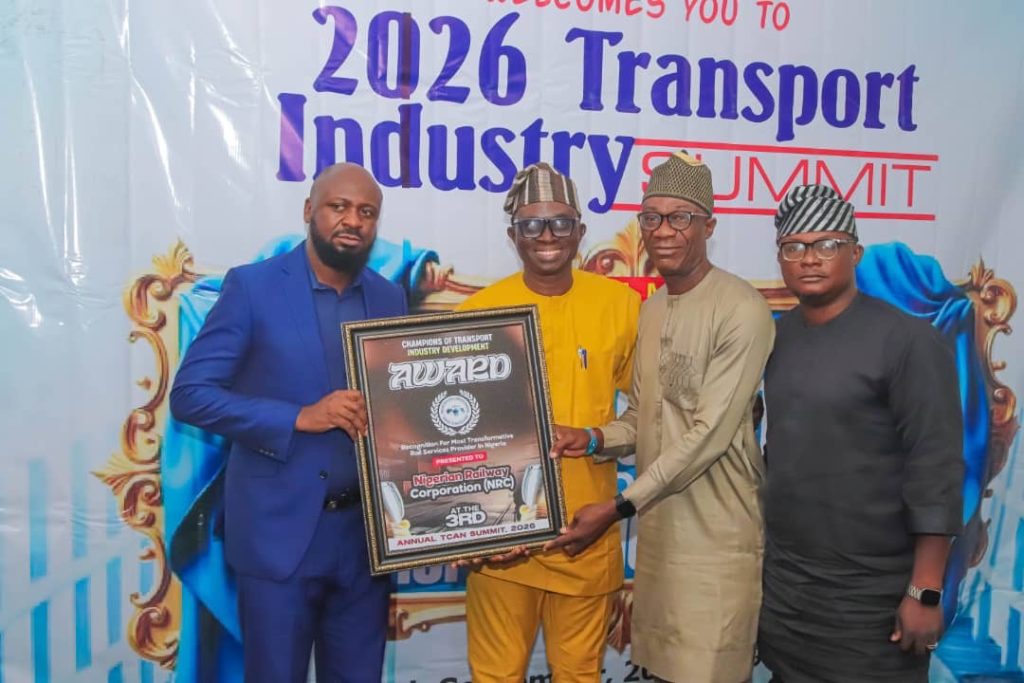
The call was made at the 2026 Transport Industry Summit organised by the Transportation Correspondents Association of Nigeria (TCAN), with the theme, “Unlocking Economic Growth Through Transportation Logistics”.
Speaking at the summit, the Managing Director of the Nigerian Railway Corporation (NRC), Dr Kayode Opeifa, said transportation should be treated as a major driver of productivity, trade, industrial development, employment and national competitiveness.
Represented at the event, Opeifa said Nigeria needed a transportation system in which rail, road, maritime, inland waterways and aviation complement one another rather than operate in isolation.
He said rail had a particularly important role to play because of its capacity to move large volumes of passengers and bulk freight over long distances, thereby reducing pressure on highways and lowering logistics costs.
According to him, the NRC is focusing not only on passenger services but also on expanding freight operations and improving connectivity between rail lines, seaports, inland dry ports, industrial centres and major economic corridors.
“The future of Nigeria’s transportation sector must also be driven by stronger partnerships. Government alone cannot provide all the infrastructure and investment required,” he said.
He called for greater private-sector participation in rolling stock, freight terminals, logistics hubs and related infrastructure, alongside a regulatory environment that promotes efficiency and innovation.
Opeifa also stressed the need to protect railway infrastructure from vandalism and encroachment, describing railway tracks, bridges, signalling systems and other assets as national investments requiring collective protection by government, security agencies, host communities and passengers.
Also speaking, the Managing Director of the National Inland Waterways Authority (NIWA), represented by the Lagos Area Manager, said Nigeria’s extensive network of rivers, creeks, lagoons and inland waterways presented significant opportunities for passenger and cargo movement.
He said waterways could provide an efficient alternative for bulk and heavy cargo, reduce pressure on roads and improve connectivity when properly integrated with road, rail and port infrastructure.
The NIWA management stressed that safety must remain central to the expansion of inland water transportation, urging operators to comply with regulatory requirements, vessel documentation, safety equipment and navigation standards.
The authority also called for increased private investment in terminals, jetties, passenger transportation, cargo movement, vessel development, logistics services and technology.
It said Nigeria should begin to view waterways as “investment corridors, not merely transportation routes”.
On technology, NIWA advocated digital tracking, electronic documentation, vessel monitoring, traffic management, route planning and data-driven decision-making to make logistics safer and more predictable.
The authority argued that an efficient logistics system should allow businesses to know where their goods are, when they will arrive and the cost of moving them.
Meanwhile, the Special Adviser to the Lagos State Governor on Blue Economy, Oluwadamilola Emmanuel, said Lagos could no longer rely solely on its roads to meet the transportation needs of its growing population and economy.
Emmanuel said the state was investing in water transportation through initiatives including the Omi Eko Project, which seeks to introduce modern and environmentally sustainable ferries, upgrade terminals and improve connectivity between waterfront communities and major economic centres.
He said the state was also working to integrate informal boat operators into a modernised water transportation system through improved safety standards, training and participation opportunities.
According to him, improved waterways could generate opportunities beyond transportation, including waterfront tourism, fisheries, maritime logistics, private investment and employment.
“Water transportation should not be measured solely by the revenue it generates, but by the economic opportunities it enables,” he said.
He stressed the need for improved safety, technology, institutional coordination and private-sector participation, particularly as Nigeria seeks to strengthen its competitiveness under the African Continental Free Trade Area.
The Waterfront Boat Owners and Transporters Association of Nigeria (WABOTAN) also urged greater investment in Nigeria’s inland waterways, describing water transport as a potential growth driver rather than a fallback mode of transportation.
The association’s National Public Relations Officer, Chief Raymond Gold, said its members transported commuters, traders and goods across creeks, lagoons and inland waterways, particularly in areas where road transportation was inefficient or inaccessible.
He called for sustained investment in jetty infrastructure, safety standards and training of boat operators, stressing that efficient water transport could reduce congestion on roads and bridges while connecting riverine communities to the wider economy.
“Economic growth through logistics will only be truly unlocked when all four modes of transport are seen as partners rather than parallel silos,” Gold said.
The Association of Maritime Truck Owners (AMATO), in its goodwill message delivered by its National Secretary-General, Mohammed Sani Bala, urged government and stakeholders to address infrastructure and operational bottlenecks affecting the maritime logistics chain.
AMATO called for improved road and port infrastructure, weigh bridges, truck marshalling yards, stronger intermodal connections and digitalisation of logistics operations.
It also demanded action against illegal checkpoints and extortion along logistics routes and called for CNG palliatives for heavy-duty truck operators.
The association said indiscriminate parking of trucks on highways and port-access roads could be reduced through the provision of adequate truck parks and marshalling facilities.
According to AMATO, a more efficient logistics sector would translate into lower costs, faster movement of goods, increased competitiveness, greater investment and more jobs.
The stakeholders agreed that Nigeria’s transportation challenge could not be addressed through isolated investments in individual modes, but through coordinated infrastructure, regulation, safety standards, technology and private-sector participation.
They also commended TCAN for providing a platform for policymakers, regulators, operators, investors and the media to examine the role of transportation logistics in Nigeria’s economic development.
MIKE OCHONMA
mikeochonma@gmail.com
-

 Car News6 years ago
Polestar is recalls over 2000 electric cars due to software bug
-
 AVIATION6 years ago
Photo News: Air Peace commence flight operations to South Africa
-

 Technology6 years ago
Common mistakes in CO₂ emissions calculations
-
 RAIL5 years ago
36 Killed in Pakistan Train Accident
-
AVIATION6 years ago
Why are aircraft pulled by Tow trucks before takeoff
-

 Reviews6 years ago
Ferrari Portofino Specifications and Review
-
 NEWS5 years ago
FG To Spend ₦900 Billion On Fuel Subsidy In 2022
-

 Business6 years ago
2016 Volvo XC60 review and specifications