NEWS
OMAA Unveils Three New CNG, Electric Buses, Introduces Vehicle Finance

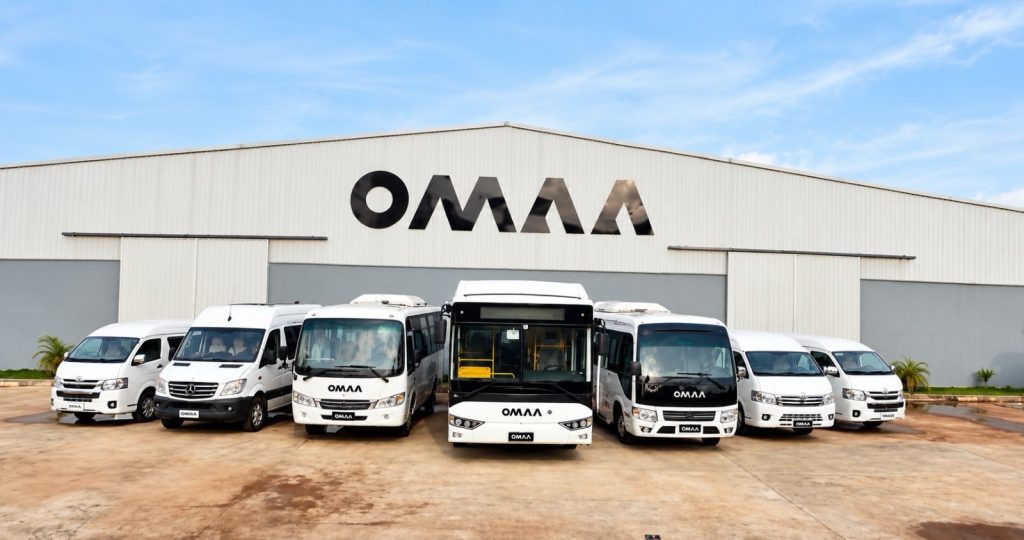
…..offers 48-month finance plans, monthly payments starting from N890,000
OMAA, a Nigerian vehicle and energy company, has unveiled three new passenger vehicle models in compressed natural gas (CNG) and battery-electric vehicle (EV) variants, alongside a vehicle financing programme designed to make fleet acquisition more accessible for transport operators and corporate organisations.
The unveiling, which coincides with the company’s sixth anniversary, features the OMAA U3 minibus, K7 bus and V12 high-capacity city bus, extending the company’s portfolio to cover passenger transportation requirements ranging from small shuttle services to large-scale mass transit operations.
The company has also opened pre-orders for the three models, offering operators the flexibility to choose between CNG and electric powertrains based on their operational requirements, route characteristics, energy infrastructure and cost considerations.
A major highlight of the announcement is the introduction of OMAA Finance, a finance programme developed in partnership with leading Nigerian financial institutions, with repayment terms spanning upto 48 months.
The initiative is intended to address one of the major challenges facing commercial transport operators: the high upfront cost of acquiring vehicles and the difficulty of matching repayment obligations with operating revenue.
Under the programme, financing is advertised as starting from N890,000 monthly, for the OMAA U3 minibus with an initial 10% deposit although individual terms will depend on applicable eligibility requirements, tenure and equity contribution.
Speaking on the development, Chinedu Oguegbu, Managing Director of OMAA, said the new vehicles and financing initiative represented the company’s determination to strengthen local automotive manufacturing while expanding access to cleaner and more cost-effective transportation solutions.
“Six years ago, we set out to demonstrate that commercial vehicles could be assembled in Nigeria and powered by cleaner, more affordable energy. Today, the introduction of the OMAA U3, K7 and V12 in both CNG and electric variants, alongside our vehicle financing programme, represents another significant step towards that vision.
“Our objective is not simply to put more vehicles on the road, but to help operators acquire the right vehicles, manage their running costs and build sustainable businesses. By combining locally supported servicing, parts availability and structured financing, we are creating opportunities for schools, hospitals, corporate organisations and mass transit operators to expand their fleets with greater confidence,” Oguegbu said.
Three models for different transport needs
The new lineup comprises three models designed to meet distinct passenger transportation requirements.
The OMAA U3 is a 12-to-15-seater minibus targeted at urban and intercity transport operators, institutional shuttle services and organisations requiring compact passenger vehicles.
The OMAA K7, with a capacity of 23 to 30 passengers, is designed for staff transportation, school buses, corporate fleets and medium-capacity passenger routes.
At the upper end of the range is the OMAA V12, a high-capacity city bus configured to carry between 43 and 70 passengers. It is intended for mass transit operators and other transport businesses serving routes with substantial passenger demand.
All three models are available in CNG and battery-electric configurations, providing fleet owners with alternative powertrain options as businesses increasingly consider energy costs and the long-term economics of vehicle operations.
The availability of both options also allows operators to assess the suitability of each powertrain against their routes, access to refuelling or charging infrastructure, vehicle utilisation patterns and maintenance requirements.
Special-purpose vehicles expand market reach
Beyond passenger transportation, OMAA is offering special-purpose vehicle configurations based on the same platforms.
These include cargo vans, ambulances, VIP transport vehicles and airport shuttles, broadening the potential applications of the company’s vehicle architecture.
The use of common platforms across different configurations could also help fleet operators simplify vehicle maintenance, spare-parts management and technical training, particularly where organisations operate multiple vehicle types.
For institutions and businesses with specialised transportation requirements, the availability of these configurations provides additional options for adapting vehicles to operational needs.
Financing targets lower ownership costs
The introduction of OMAA Finance is a central component of the company’s strategy to make its vehicles more accessible to commercial operators.
Through the 48-month finance arrangement, the company aims to help customers spread vehicle acquisition costs over an extended period rather than bear the full financial burden upfront.
The programme is structured around total cost of ownership (TCO), a measure that considers the overall cost of acquiring and operating a vehicle over its useful life.
Beyond the purchase price, TCO takes into account energy consumption, servicing, spare parts and other operating expenses that influence the profitability of commercial fleets.
OMAA said its financing proposition combines structured monthly repayments with locally supported servicing and spare-parts availability, allowing operators to plan their expenses and manage fleet expansion more effectively.
The company said eligibility requirements, deposit obligations and indicative comparison of the vehicle ownership costs are available on their website.
However, the actual financial benefits will depend on the vehicle selected, financing terms, energy prices, utilisation levels and the availability of appropriate refuelling or charging infrastructure.
Building on six years of local operations
Headquartered in Umunya, Anambra State, with offices in Lagos, Abuja and Accra, OMAA operates across Nigeria and Ghana, serving fleet operators, institutions and businesses.
The latest announcement builds on the company’s six-year operating history and reflects its efforts to combine local vehicle assembly with alternative energy solutions and financing options.
With transport operators facing pressure to manage rising operating expenses, the availability of CNG and electric vehicles, supported by structured finance arrangements, could provide additional choices for businesses seeking to modernise their fleets.
The success of the initiative will ultimately depend on the vehicles’ performance under local operating conditions, the accessibility of financing, the reliability of after-sales support and the development of infrastructure needed to sustain CNG and electric mobility.
For OMAA, the launch represents an effort to move beyond vehicle supply towards an integrated commercial mobility proposition combining vehicle acquisition, energy choices, maintenance support and financing.
MIKE OCHONMA
mikeochonma@gmail.com
-
 Car News6 years ago
Polestar is recalls over 2000 electric cars due to software bug
-
 AVIATION6 years ago
Photo News: Air Peace commence flight operations to South Africa
-

 Technology6 years ago
Common mistakes in CO₂ emissions calculations
-
 RAIL5 years ago
36 Killed in Pakistan Train Accident
-

 Reviews6 years ago
Ferrari Portofino Specifications and Review
-
AVIATION6 years ago
Why are aircraft pulled by Tow trucks before takeoff
-
 NEWS5 years ago
FG To Spend ₦900 Billion On Fuel Subsidy In 2022
-

 Business6 years ago
2016 Volvo XC60 review and specifications