
NEWS
Nigeria Auto Industry Bill: NADDC advances legislative framework to protect stakeholders

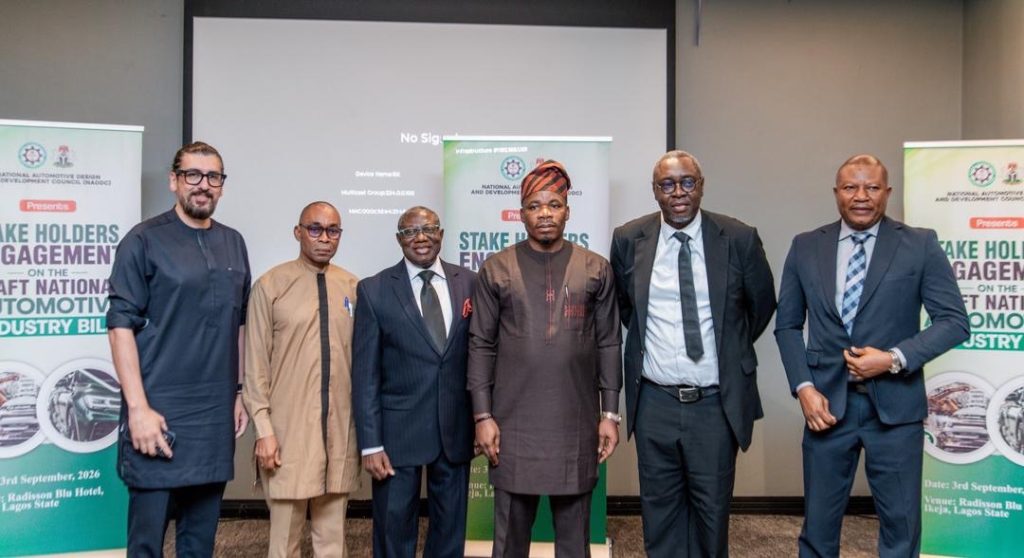
The National Automotive Design and Development Council (NADDC) has commenced moves to finalise the proposed National Automotive Industry Bill, 2026, assuring stakeholders that the clean copy of the document will be ready soon.
The Council gave the assurance on Thursday, September 2. 2026 at a Stakeholders’ engagement forum on the Draft Bill in Lagos, where automotive manufacturers, assemblers, component suppliers, industry associations and other stakeholders reviewed the proposed legislation.
As part of NADDC’s efforts to strengthen the legal, regulatory and institutional framework for sustainable growth of the sector, the stakeholder engagement was put together to bring together major players across the automotive value chain to review the proposed legislation and make recommendations ahead of its submission to the National Assembly.
Speaking at the event, the Director-General of NADDC, Otunba Oluwemimo Joseph Osanipin, said the engagement reflected a shared commitment to developing a legal framework capable of transforming Nigeria’s automotive ecosystem into a self-sustaining and globally competitive industrial value chain.
Addressing stakeholders, Osanipin said “when this management team assumed leadership at the NADDC, our vision was clear: to move Nigeria’s automotive ecosystem from mere assembly potentials into a robust industrial value chain anchored on local content, component manufacturing, vehicle electrification, and regional market integration”.
“However, achieving this ambition requires an unyielding foundation. Policy inconsistency, legislative gaps, and outdated legal frameworks have historically created uncertainty for investors. The National Automotive Design and Development Council Act of 2014 laid important groundwork, but the dynamics of global manufacturing, green mobility transitions, and regional trade integration particularly under the African Continental Free Trade Area (AfCFTA) demand that we upgrade our legal architecture”.
“The Draft National Automotive Industry Bill, 2026, represents a bold legislative reform. By transitioning the Council into the National Automotive Design & Development Commission, this Bill aims to: stablish a statutory institutional framework with strong regulatory and enforcement mandates; legally safeguard the incentives, protections, and implementation structures of the Nigerian Automotive Industry Development Plan (NAIDP); create a predictable, transparent, and investment-friendly environment that gives original equipment manufacturers (OEMs), component suppliers, and financiers the confidence to commit long-term capital to Nigeria and fast-track local value addition, supplier development, and sustainable job creation for our youth’, he said.
As a Council, the DG pointed out that, they firmly believe that legislation designed for the private sector must be written with the private sector. The draft Bill before you today is not a finished product cast in stone; it is a collaborative template. We have deliberately convened this session to listen to you, the plant managers, local assemblers, component manufacturers, and key industry bodies like NAMA and MAN who navigate the daily operational realities of our market.
“We want to know: Where do these provisions support your growth? Where do they create bottlenecks? How can we refine this framework to position Nigeria as the undisputed automotive manufacturing hub of West Africa?”, he added.
In his remark, the Director, Policy, Planning and Statistics (PPS), Mr. Umar Nura Sidi, described the engagement as a decisive step towards redefining the legal, regulatory and economic architecture of Nigeria’s automotive sector.
Sidi said the Council deliberately circulated the Draft Bill to stakeholders to ensure that the proposed legislation reflected the realities of those investing, manufacturing, assembling and operating within the industry.
He disclosed that valuable written contributions had already been received from major industry stakeholders, including the Nigerian Automotive Manufacturers Association (NAMA) and the African Association of Automotive Manufacturers (AAAM).
Also speaking at the forum, Chairman of the Nigerian Automotive Manufacturers Association (NAMA) , Mr Bawo Omagbitse expressed support for the enactment of a modern National Automotive Industry Act, adding that substantial amendments were required to ensure that the legislation functions not only as a regulatory framework but also as a catalyst for automotive industrialisation.
Calling for a performance-based policy framework capable of driving investment, local manufacturing and component development, Omagbitse said the fundamental issue the Bill must address was whether its provisions would make it commercially attractive for investors to manufacture vehicles and components in Nigeria rather than rely on imports.
He said the automotive sector was an anchor industry with extensive linkages to steel, aluminium, plastics, rubber, glass, batteries, electronics, chemicals, engineering, logistics, finance, ICT, technical education and research and development.
According to him, the proposed law should establish a clear and balanced industrial compact between government and investors, with government providing predictable policies, appropriate incentives, market support and investment protection, while industry commits to measurable targets in investment, production, employment, local content, supplier development, technology transfer, research and development and exports.
He said “We recognise the need to replace the existing legal framework with legislation that reflects the changing realities of our industry, including new technologies, electric mobility, consumer protection, standards, vehicle safety and the growing importance of local manufacturing. However, after a careful review of the proposed Bill, the industry believes that substantial amendments are required before the Bill is passed into law. Our principal concern is that the Bill, in its present form, is stronger as a regulatory and institutional law than as an industrialization law. It provides for licensing, standards, inspection, penalties, testing, consumer protection, clean mobility and administration of industry funds. These are important provisions.
Raising a fundamental question before the industry, Omagbitse who is also on NADDC Board representing NAMA said “what will make it commercially rational for an investor to manufacture vehicles and components in Nigeria rather than simply import them into Nigeria? That question, he said must be at the heart of this legislation.
“The automotive industry is not an ordinary trading sector. It is an anchor industry with linkages to steel, aluminum, plastics, rubber, glass, batteries, electronics, chemicals, engineering, logistics, finance, ICT, technical education and research and development. A successful automotive industry, therefore, does much more than assemble vehicles. It creates an industrial ecosystem. Nigeria’s current automotive policy already sets ambitious objectives: the transition from SKD to CKD production, increased local content, increased domestic production, employment generation and the development of locally produced new-energy vehicles”.
The proposed legislation should do more than restate these aspirations. The Nigeria Automotive Industry Act, 2026 should create the legally predictable mechanisms that make the aspirations commercially achievable. Our recommendation is that the Bill should establish a clear and balanced industrial compact between Government and investors. Under this compact, Government would provide predictable policies, appropriate incentives, market support and investment protection. In return, industry would undertake measurable commitments to investment, production, employment, local content, supplier development, technology transfer, research and development and, where commercially feasible, exports. This simply implies that no industrial incentive without industrial performance and no industrial performance obligation without predictable Government support. That, in our view, is the balance that is presently missing from the Bill.
He recommended that the Bill should be strengthened around a number of critical pillars, including: investment and policy certainty. establishment of a predictable Automotive Tariff and Industrial Protection Framework that must be a clear and rational relationship between the tariff treatment of Fully Built Vehicles; SKD kits; CKD kits and locally manufactured components: a strong and practical local-content and component-development programme: establishment of a properly structured Automotive Development Fund. The fund proposed in the Bill is potentially one of its most important provisions, but it must be properly governed and ring-fenced and market creation.
According to him, NAMA believes the Bill provides an important opportunity to establish a modern and durable legal framework for the Nigerian automotive industry. But it should not become merely a stronger regulatory law, it must become an equally strong automotive industrialization law.
“The legislation must help Nigeria move: from SKD assembly to CKD manufacturing; from vehicle assembly to component integration; from import dependence to local value creation; and ultimately and from a protected domestic market to a competitive African automotive production base.
“We look forward to working with the National Assembly, the Federal Government, NADDC, other regulatory agencies and all stakeholders to refine this Bill into legislation that provides not only rules for the automotive industry, but a credible pathway for its growth and industrial transformation”, Omagbitse emphasised.
The interactive session organised by NADDC attracted the whole gamut of industry players including: automotive manufacturers, assemblers, component suppliers, industry associations and other stakeholders who reviewed the proposed legislation. The clean copy of the proposed National Automotive Industry Bill, 2026 is expected to be ready before the end of the year.
MIKE OCHONMA
Editor
mikeochonma@gmail.com
-

 Car News6 years ago
Polestar is recalls over 2000 electric cars due to software bug
-

 AVIATION6 years ago
Photo News: Air Peace commence flight operations to South Africa
-

 Technology6 years ago
Common mistakes in CO₂ emissions calculations
-

 RAIL5 years ago
36 Killed in Pakistan Train Accident
-

 Reviews6 years ago
Ferrari Portofino Specifications and Review
-
AVIATION6 years ago
Why are aircraft pulled by Tow trucks before takeoff
-

 NEWS5 years ago
FG To Spend ₦900 Billion On Fuel Subsidy In 2022
-

 Business6 years ago
2016 Volvo XC60 review and specifications