
NEWS
NADDC, BPP Target Government Patronage for Made-in-Nigeria Vehicles

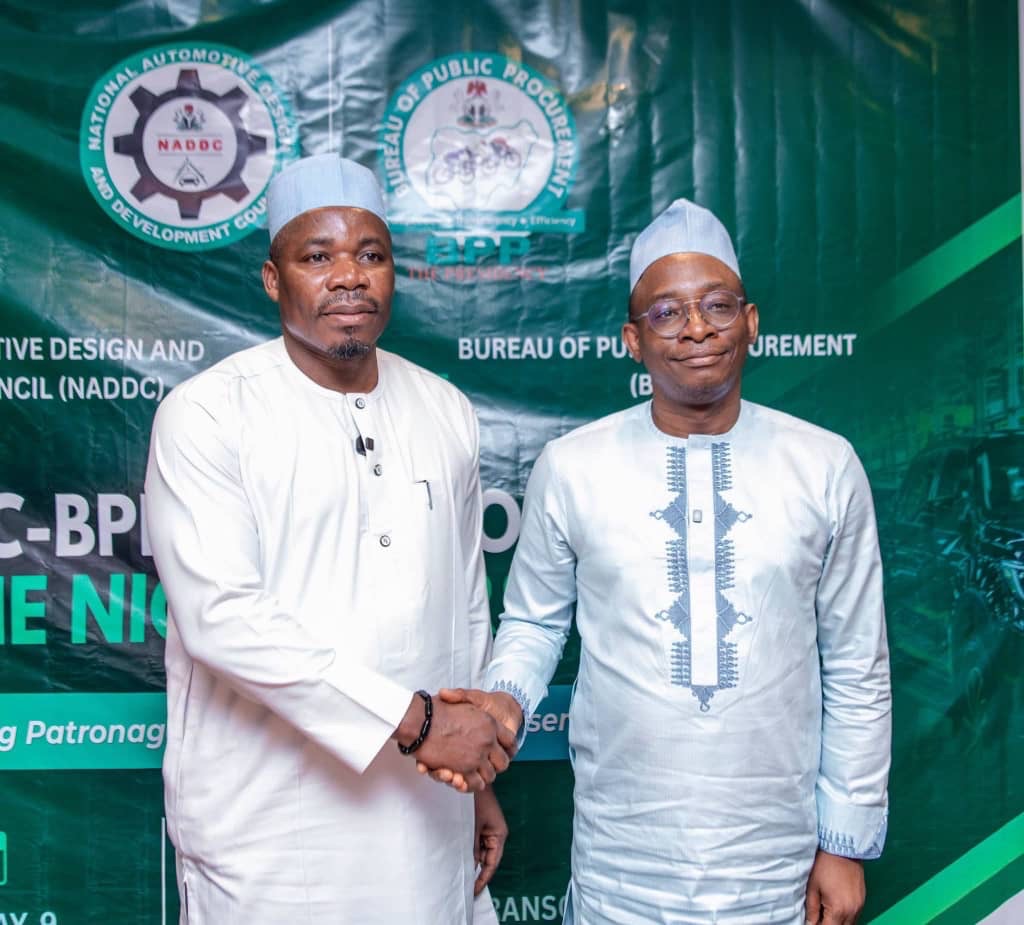
…seeks local production, job creation, stronger automotive value chain.
The National Automotive Design and Development Council (NADDC) and the Bureau of Public Procurement (BPP) have intensified efforts to make government patronage a major driver of local automotive manufacturing under the Federal Government’s Nigeria First Policy.
The initiative is aimed at strengthening domestic vehicle assembly, expanding the production of automotive components, creating employment opportunities and reducing Nigeria’s dependence on imported automotive products.
The two agencies announced their commitment at a press conference held on October 9, 2026, at the Transcorp Hilton Hotel, Abuja, where they outlined plans to develop an implementation framework that would encourage government institutions to prioritise locally manufactured vehicles and automotive components.
Director-General of NADDC, Otunba Oluwemimo Joseph Osanipin, said the Council was working to support local vehicle assemblers in moving beyond Semi-Knocked Down (SKD) assembly to Complete Knocked Down (CKD) production, a transition expected to deepen local manufacturing and increase the contribution of Nigerian component suppliers to vehicle production.
According to him, expanding domestic production would create fresh opportunities for local automotive component manufacturers, stimulate investment and strengthen linkages across the automotive value chain.
Osanipin stressed that effective implementation of the Nigeria First Policy would require close collaboration between NADDC, BPP, vehicle assemblers, component manufacturers and other industry stakeholders.
He added that companies that failed to comply with established government automotive regulations could lose access to government patronage, underscoring the need for manufacturers and suppliers to operate within the applicable regulatory framework.
The NADDC chief executive explained that consistent government purchases of locally manufactured vehicles and components would provide the market assurance needed by investors to expand production, reinvest in their businesses and create more jobs.
He maintained that the policy represented an important opportunity to build a competitive and sustainable automotive industry capable of meeting domestic demand while increasing Nigeria’s manufacturing capacity.
Also speaking, the Director-General of BPP, Dr. Adebowale Adedokun, disclosed that the Bureau was developing an institutional framework, standard policies and an appropriate circular to guide the implementation of the Nigeria First Policy across relevant government institutions, in line with President Bola Ahmed Tinubu’s directive.
Adedokun said the Federal Government was moving beyond policy pronouncements by engaging local automotive assemblers to understand the operational challenges confronting domestic manufacturers, particularly the need for stronger demand for locally produced vehicles and components.
He explained that the policy was designed to strengthen Nigerian enterprises by encouraging public institutions to patronise products manufactured locally, thereby helping domestic businesses expand their production capacity and compete more effectively.
According to him, Nigerian manufacturers already produce automotive components such as wipers and bolts, but require stronger market support to sustain operations, increase output and attract further investment.
He noted that improved patronage of locally manufactured products would support industrialisation, create employment for skilled workers and technicians, and open up more opportunities for young Nigerians seeking careers in manufacturing and related industries.
The BPP chief added that expanding domestic production would also encourage technology transfer, skills development and stronger local supply chains while reducing reliance on imported automotive products.
Industry observers consider effective implementation of the Nigeria First Policy crucial to addressing one of the longstanding challenges confronting Nigeria’s automotive sector: the limited demand for locally assembled vehicles and domestically manufactured components.
For local assemblers and component manufacturers, sustained government patronage could provide the demand needed to justify investments in production facilities, equipment, workforce training and improved manufacturing processes.
However, the success of the initiative will depend on the effectiveness of its implementation framework, compliance monitoring and the willingness of government institutions to translate the policy into procurement decisions that support local industry.
NADDC and BPP reaffirmed their commitment to working with manufacturers and other stakeholders to ensure that the policy delivers measurable economic benefits.
Both agencies expressed optimism that effective implementation would strengthen Nigeria’s automotive manufacturing base, improve local content development and position the country to supply vehicles, components and related products to markets across the Economic Community of West African States (ECOWAS) and the wider African continent.
MIKE OCHONMA
mikeochonma@gmail.com
-

 Car News6 years ago
Polestar is recalls over 2000 electric cars due to software bug
-

 AVIATION6 years ago
Photo News: Air Peace commence flight operations to South Africa
-

 Technology6 years ago
Common mistakes in CO₂ emissions calculations
-

 RAIL5 years ago
36 Killed in Pakistan Train Accident
-

 Reviews6 years ago
Ferrari Portofino Specifications and Review
-
AVIATION6 years ago
Why are aircraft pulled by Tow trucks before takeoff
-

 NEWS5 years ago
FG To Spend ₦900 Billion On Fuel Subsidy In 2022
-

 Business6 years ago
2016 Volvo XC60 review and specifications