
NEWS
NAMA asks FG To Tie 2026 Auto Tariff Reforms With Industrial Safeguards To Protect Local Investments

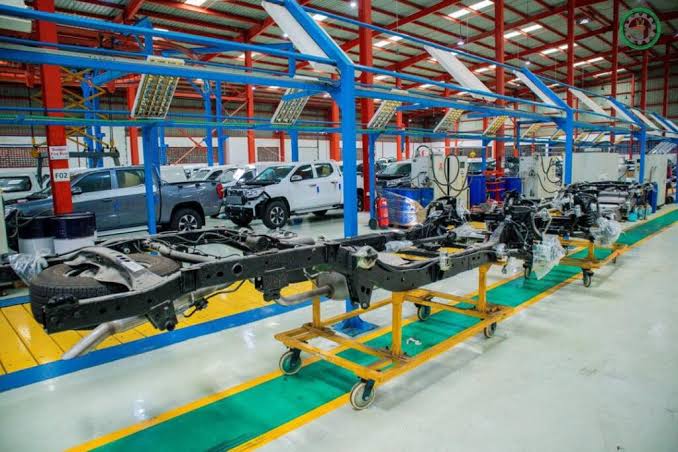
The Nigerian Automotive Manufacturers Association (NAMA) has called on the Federal Government to pair its 2026 Fiscal Policy Measures with a comprehensive industrial support framework, cautioning that the country’s automotive manufacturing sector could face avoidable setbacks if tariff liberalisation runs ahead of the safeguards local assembly depends on.
In a position paper submitted to the Honourable Minister of Industry, Trade and Investment and shared with the National Automotive Design and Development Council (NADDC), the association noted that the current measures advance trade liberalisation without the corresponding industrial safeguards required to sustain local vehicle assembly and component manufacturing.
The paper, signed by NAMA Chairman Mr. Bawo Omagbitse and the association’s Executive Director and Chief Executive Officer, Dr. Harpreet Singh, acknowledged the Federal Government’s efforts to stimulate the economy and to align Nigeria’s trade policy with the ECOWAS Common External Tariff and the African Continental Free Trade Area. It welcomed measures that favour locally manufactured vehicles, the End-of-Life Vehicle Policy and the Vehicle Conformity Assessment Programme.
NAMA, however, expressed concern that the narrower duty differential between imported fully built units and locally assembled vehicles could erode decades of effort to build Nigeria’s automotive industry, reducing the protection margin local manufacturers rely on to reach economies of scale and deepen local content.
“Nigeria’s automotive industry is still at an infant to intermediate stage. Affordability for buyers and protection for the investment that creates jobs are not in conflict, and our appeal is that the two move together,” said Mr. Bawo Omagbitse, Chairman of NAMA.
Citing official Nigerian Ports Authority data, the association noted that vehicle imports rose by 67 per cent year on year, from 35,262 units in the first quarter of 2025 to 58,870 units in the same period of 2026, a surge that preceded the latest measures and, in NAMA’s assessment, reflected importers anticipating lower duties on fully built vehicles.
The association warned that premature liberalisation could increase import penetration, lower assembly volumes and capacity utilisation, and weaken the economic case for investment in assembly lines, welding and painting plants, and in local production of plastics, tyres, batteries, automotive glass and other components.
“We fully support the government’s goals on affordability, revenue efficiency and regional integration,” said Dr. Harpreet Singh, Executive Director and Chief Executive Officer of NAMA. “Our request is simply that these gains be sequenced with the industrial incentives that every successful automotive economy put in place before opening its market.”
NAMA pointed to Thailand, Morocco, South Africa and China as economies that combined tariff protection with production incentives, supplier development, export promotion and infrastructure support before liberalising their automotive markets.
In a candid review of Nigeria’s automotive policy between 2014 and 2020, the association acknowledged that localisation and capacity utilisation had remained limited, attributing this largely to the absence of legislation backing the Nigeria Automotive Industry Development Plan (NAIDP) and the long-term certainty investors need to commit capital.
To protect the sector, NAMA proposed three priority measures: restoring a more substantial duty differential between imported and locally assembled vehicles, making consultation with NADDC and the Ministry mandatory on future automotive fiscal policy, and the urgent passage of the NAIDP into law.
The association further recommended production-linked incentives, an automotive supplier development fund, priority foreign-exchange access for industrial inputs, and dedicated energy and logistics support for manufacturers.
“Nigeria risks becoming a large vehicle consumption market without becoming a meaningful automotive manufacturing economy,” the association stated, adding that the country’s automotive future depends on balancing market liberalisation with sustained industrial development. NAMA reiterated its readiness to engage the Minister of Industry, Trade and Investment and the Director-General of NADDC, and affirmed its commitment to the Federal Government’s broader economic reform agenda.
About NAMA
The Nigerian Automotive Manufacturers Association is the representative body for vehicle assemblers and component manufacturers licensed to operate in Nigeria. It works with government, regulators and industry to advance sustainable automotive manufacturing, local content.
MIKE OCHONMA
mikeochonma@gmail.com
-

 Car News6 years ago
Polestar is recalls over 2000 electric cars due to software bug
-

 AVIATION6 years ago
Photo News: Air Peace commence flight operations to South Africa
-

 Technology6 years ago
Common mistakes in CO₂ emissions calculations
-

 RAIL5 years ago
36 Killed in Pakistan Train Accident
-

 Reviews6 years ago
Ferrari Portofino Specifications and Review
-

 Business6 years ago
2016 Volvo XC60 review and specifications
-

 NEWS5 years ago
FG To Spend ₦900 Billion On Fuel Subsidy In 2022
-

 Reviews6 years ago
2021 Audi A6 Specifications and Review